

Why some people grow from suffering and others don't
A story about my mother, my aunt and the practice that separated them.

Issue #73:
Good day and welcome back to The Zen Journal. Today's reflection is on how suffering is neutral. It's what you do with it, that is where growth lives or dies.
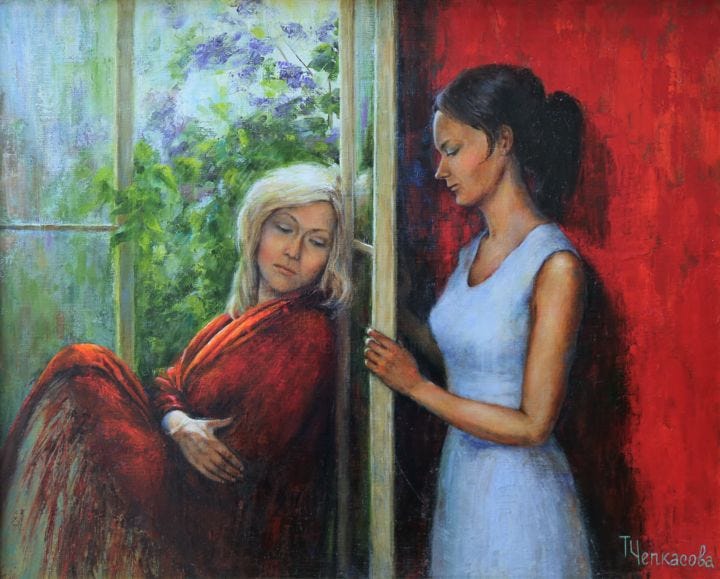
My mother and her sister lost their mother when they were children.
Same loss, same grief. They grew up in the same house, with the same lack and the same ache. If you had asked anyone back then who would turn out fine and who wouldn’t, no one could have said anything. There was nothing to distinguish them. They were both quiet, both bright, both wounded in the way only motherless children can be.
Today, decades later, they live in two completely different inner (and outer) worlds.
My mother has spent her adult life reading books on personal development. She sits in meditation in the early morning before the rest of the house wakes up. She has, somehow, made peace with what was taken from her, not by forgetting it, but by sitting with it long enough that it stopped being a wound and started being a teacher. She speaks of her mother now with tenderness, not bitterness. She is, by far, the kindest person I know.
My aunt has spent her adult life replaying the same grief, same stories, same villains, same sense of having been cheated by life. Fifty years on, her conversations still return to those early losses, but not with wisdom. Instead, with resentment that has hardened into identity. She is depressed in a way that has stopped being a phase and become a personality.
Same starting point, same loss, completely different people.
For a long time, I assumed suffering automatically produced wisdom. That pain was a kind of teacher who educated everyone the same. Watch enough of life, lose enough, struggle enough and you would naturally emerge clearer on the other side.
But my mother and my aunt prove that this isn’t true.
Suffering doesn’t teach anyone anything by itself. Suffering is just suffering. It is neutral.
What you do with it is where growth lives or dies.
“We do not learn from experience. We learn from reflecting on experience.”
Experience alone teaches nothing. You can go through the same painful situation a hundred times and learn nothing. You can lose and lose and lose and emerge no wiser. It is not the experience that educates. It is the reflection, the pause, the examination, the willingness to look at what happened and ask what it meant.
Without reflection, experience is just time passing.
“Until you make the unconscious conscious, it will direct your life and you will call it fate.”
This is what happens to people who don’t reflect. The unconscious patterns run the show. They keep attracting the same situations, the same relationships, the same pain and they call it bad luck. They genuinely believe life is just happening to them.
But it is not happening to them. It is happening through them.
My aunt would tell you that life has been unfair to her. And in many ways, it has. But what she cannot see is that her unexamined grief has been shaping every choice she has made for the last 50 years. The wound is still driving. She just cannot see the driver.
Reflection is how you bring the driver into the light.
There’s something else I have learned, mostly from watching my mother.
Reflection is not just intellectual. It is not just thinking carefully about what happened.
Reflection requires feeling.
And this is where most people stop, because feeling is painful. Especially when what you’re feeling is grief, shame, fear or regret. So we skip it, we distract, we stay busy. We tell ourselves we’re fine, we’re over it, we’ve moved on.
But the feelings are still there, unfelt, running the show from the basement.
My mother didn’t grow by avoiding her grief. She grew by sitting with it. Quite literally, in meditation, in long evenings on the verandah, in the books she would read and re-read. She let the grief move through her instead of around her. And slowly, over years, it changed shape. It became something she could hold, instead of something that held her.
My aunt never sat with anything. She kept moving, kept talking, kept blaming. The grief never had a chance to become anything else.
“It’s not what happens to you, but how you react to it that matters.”
We quote this often. But what it actually asks of us is enormous. It asks for a gap between stimulus and response. A pause. A moment where you choose your reaction instead of just having one.
Without that gap, you are a pinball. Life bounces you around and you react automatically, from old patterns and unexamined wounds.
There is a final piece I want to name, because it is the one I have thought about the most.
People who grow through hardship almost always have some practice that creates distance from their inner life. A way of stepping back from the storm so it can be seen rather than just survived. There are roughly two kinds.
The first is externalization. Taking what is inside your head and putting it outside, where it becomes an object you can examine. Journaling, therapy, deep conversations with a trusted friend. Any practice that moves the inner experience into a form you can actually look at.
The second is internal observation. Stepping back inside yourself to watch the thoughts and feelings from a slight remove. Meditation, in any of its forms, is the main one. Instead of moving the inner outward, you create a small gap within. The observer & the observed.
Both produce the same gift: perspective. Both break the loop of rumination, which is what reflection becomes when it has no exit. My aunt has been “reflecting” on her grief for 50 years, but it is not reflection. It is rumination. The thoughts go in circles. They never make it out into a notebook or a conversation where they could be examined and they are never watched from any inner stillness either.
My mother, by contrast, has done both. The reading, the re-reading, the long talks, the writing in the margins of her books, that is the outward route. The morning meditation, the long evenings sitting with what she felt, that is the inward route. Two practices, the same gift.
This is partly why I have been building Mindwise. I initially thought of it as a personal tool, somewhere to put my own reflections, especially during a long stretch of job hunting when I could not tell whether I was growing or just spiraling. Then I began building it alongside someone who was working through similar things in his own life. And what started as a journal for one, quietly became something much larger. The more we talked, the more we realized we were not building a journaling app. We were trying to build the kind of structured path neither of us had ever been handed.
The tools for inner work have existed for thousands of years. Meditation, journaling, The Stoic evening review, contemplative reading. None of this is new. What is new is how few people actually do it, not because they don’t believe in it, but because they have no structure for it. No daily on-ramp, no sequence that builds, no sense of what to work on this week versus next. They sit down, feel overwhelmed and close the notebook again.
That is what Mindwise is. Think of it as Duolingo for personal development. Short, structured daily sessions that walk you through both routes: reflection and practices on the outward side. Frameworks from Zen, Stoicism, Cognitive Behavioural Therapy, etc. running underneath. A path that meets you where you are and gently moves you forward, one small day at a time.
I am not trying to sell anything here. I just want to be honest about why I am building it, because this article is essentially what the app is for. My mother taught herself this work over decades. Slowly, alone, with whatever books happened to find her. Most people will not. Not because they cannot, but because no one ever handed them the curriculum.
You do not need an app for this. My mother never had one. A notebook works just fine. A trusted friend works. A walk and a voice memo could work too. A cushion and a quiet half-hour daily works.
But if you are someone who has tried to journal three times this year and stopped each time or who knows you should meditate but never quite begins, the missing piece is almost always structure, not willpower.
Either way, the principle is what matters. Whether the distance comes from putting your inner life onto a page or from watching it from a quiet seat within, the mechanism is the same. Distance allows perspective. Perspective enables growth.
If you are going through something hard right now, you have a choice. The hardship does not care either way. The hardship is just the hardship.
But you will care. Years from now, you will look back and see either growth or repetition. The difference is made now. In this moment. In your willingness to stop, examine, feel and ask better questions of yourself.
We do not learn from experience alone. We learn from reflecting on experience. The hardship has already happened. What you become because of it is still being written.
I look forward to continuing this journey with you. Please feel free to share your thoughts, reflections or questions as I dive deeper into these teachings.

Thank you for this. I love the line reflection brings the driver to the light. I have only just begun to learn that the one who has been driving was been out of control, too found of the accelerator and no idea how to use a break. This was a really helpful piece, reminding me that I need to create the time and space to grow
Very rich piece of work. I've fallen in to your mother's camp, and a sister of mine in to your aunt's camp. Nothing for me to do as she's framed me in her head and heart as the problem. I've moved on.